On the 26th of April the Pomegranate Team was awarded by the Minister of Education for the distinction of ATOM. Half of us, without Eleni and our kids, that were having the time of their lives in Antalya, tried to explain what ATOM meant to us : Here it is !
Showing posts with label Elefsina. Show all posts
Showing posts with label Elefsina. Show all posts
4.28.2012

9.23.2011
One more quality label for AToM


We'd like to thank all our colleagues for this collaboration and wish the project all the best!
6.11.2011
"A mathematician's diet" Elefsina's farewell song
Pythagoras, the 6th century B.C. Greek mathematician, scholar and so much more, was a vegetarian and thought that beans were kin to men, so they shouldn’t be eaten. More theories on bean abstinence here
Look out for our film on Pythagora's banquet in Food for thought!

Eratosthenes, the 3rd century B.C. Greek mathematician was able to culculate the earth’s circumference with great proximity. Of course he thought it was a sphere, but mankind forgot that for many centuries later. He starved himself to death, when he realized he was going blind.
More Math and diet trivia:
The Tyrian mathematician Porphyry Malchus, Eratosthenes’ contemporary, was a vegetarian, since he was influenced by Pythagorian theories about animals having a soul.

Kurt Gödel, Eistein’s friend, and one of the most important people of the 20th century, who proved that one cannot attain absolute mathematical truth (incompleteness theorem), starved himself for fear of getting poisoned.
Please remember: Millions of mathematicians were normal eaters!!
5.10.2011
5.05.2011
Atom in Greek Student Festival 2011
It took us several hours of work to prepare an old table with wheels and paint it, so it would become the AToM exhibition table in the library. But when we were invited to show the project in the annual student festival in Elefsina, it proved really handy, with all the food and info about Maths and Cooking. Among other things, we made the Avila cookies again (thank you very much, Avila, and many thanks, once more, AToM mom for making them), the fractal salad, we offered a little port with walnuts, the prize for mathematical excellence in Trinity College, England, and added Eratosthenes' sieve, a nice way to find the prime numbers. Click here and see how many "holes" the sieve will have! Of course there were a lot of other things to include, from all countries, but...the table wasn't big enough, so visitors were prompted to visit the AToM blog.
Thank you Elefsina and Karvina!
Hi students and teachers from Elefsina and Karvina,
We would like to thank you for our presents. Here some photos of us receiving and using your presents!

Already in use! Photo taken by my 6-year old son...


Thank you!!!
We would like to thank you for our presents. Here some photos of us receiving and using your presents!

Already in use! Photo taken by my 6-year old son...


Thank you!!!
4.27.2011
4.18.2011
Happy Easter from Greece!

3.14.2011
Happy Pi Day from the native speakers!

- Ἀεὶ ὁ Θεὸς ὀ Μέγας γεωμετρεῖ,
- τὸ κύκλου μῆκος ἵνα ὁρίσῃ διαμέτρῳ,
- παρήγαγεν ἀριθμὸν ἀπέραντον,
- καὶ ὅν, φεῦ, οὐδέποτε ὅλον θνητοὶ θὰ εὕρωσι
- The Great God applies geometry forever;
- To define the length of the circle using its diameter,
- He produced an infinite number,
- Which, alas, mortals will never find in its entirety.

- The image comes from a 13th century manuscript in France, depicting Christ as a geometre, and it seems to suit the above mnemonic well.
3.08.2011
Dutch answer to the Greek task
Here our answer to the Greek task. In two parts: how we worked and a little video of the answer!
2.25.2011
The Math Task from Greece
Here is a simple (or so it seems) math task for the next etwinners in line:
Try to make 4 equal squares by moving only 2 bread sticks from the initial shape. See our trials and errors, so you pick up where we left off. The correct answer will be given only if you give up! Good luck!!
(By the way we ate our math task, since we had a meeting after school and were a bit hungry)
2.11.2011
The secret geometry
The secret geometry in the School of Athens Rome
By G. Matzaridis. Translated by the Pomegranate team seeds Vretti Kotorou and Natalie Mantikou.
By encircling Plato’s and Aristotle’s heads, I include their thoughts and theories in a circle.


By connecting the two philosophers’ eyes, the circle’s diameter is created. Right after that, I draw the middle vertical line of the diameter. The intersection of the diameter and the vertical line is the center of the circle. I draw two lines starting from the center of the circle, each ending on Pythagoras’ and Euclid
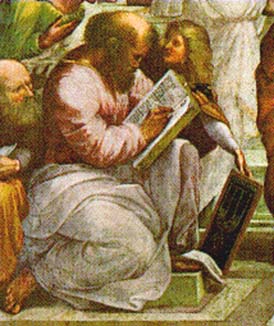
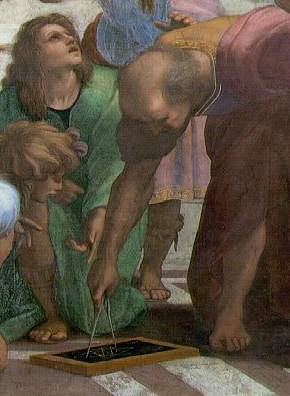
I draw the bisectors of the base-angles of the triangle, the extension of which points directly to Thucydides and Aeschenes. Then, I extend the lines of the triangle’s sides towards Apollo and Athena, I connect the ending points and another isosceles triangle is created!


I draw the bisectors of the two angles of the new triangle, and they once again point to Thucydides and Aiskenes. Then, from the center of the circle, I draw the verticals of the two isosceles triangles. The extension of the line shows the perspective of the painting. The triangles’ vertical creates 4 rectangular triangles. From the latter, I draw the verticals of each right angle. The straight line which unites the two intersections of the four verticals passes from the center of the painting and intersects all of the philosopher’s heads.
Conclusion: The major impact of the ancient Greek way of thinking on Renaissance artists. The interrelationship of the ancient world’s sciences.
The greatness of Art as the highest form of expression.
Conclusion II : “Let no one ignorant of geometry enter” in Plato’s academy. It seems that the ones who did enter, did it through Raphael’s brush. None the less, we, the fresco’s admirers, “entered” the painting only when we discovered the geometrical patterns that are revealed in the painting. Only then did we come to appreciate the deep symbolism it conveys.
2.04.2011
The Fibonacci poem from Greece

Fighting
Famine
Bread, Beans
Poor man’s food
Savored once in ancient Greece
Wheat was gifted by the gods to us
Soup made of holy beans, raised the world’ s brightest brains whose methodology remains
Beans, Bread, as divine med, sent from heaven to heal and spread.
Wondrous works were read and made within philosophy’s array.Μια
Φασολάδα
Και ψωμί
Ισοδυναμεί με ευχή
Στων τότε Ελλήνων το τραπέζι
Ευλογία των θεών, είν’ το «κρέας των φτωχών»
Σίτος, δώρο της θεάς, άρτος έγινε για μας, παντού δίνοντας ζωή, ανάλαφρη αναπνοή
Μαθηματικά μυαλά ξύπνησαν με όλ’ αυτά, και φιλόσοφοι μεγάλοι άρχισαν ανεμοζάλη στων επιστημών τον κόσμο όλα άλλαξαν διαμιάς κι έμειναν αθάνατα.
1.03.2011
Logo contest - the winners!


Here are the six winning logos from every country. The teachers are now going to vote between these six logos to decide the overall winner.
Congratulations to these six winners!
12.20.2010
Xmas Greetings from Elefsina
On the twelfth day of Xmas, my true love gave 2 me
Twelve perfect numbers,
Eleven loops a-leaping,
Ten tangents touching,

Nine diameters,
Eight hypercubes,
Seven spirals spinning,
Six Cantor’s circles,
FIVE MATH RINGS,
Four fractal sets,
three dragon curves,
two square roots and an Axiom of geometry!
11.26.2010
Elefsina

Here is Elefsina, its archeological site, as photographed yesterday by the Pomegranate team. The puzzle is 2.300 years old and it belongs to Archimedes, the ancient mathematician, one of the three greatest ever. You can print and cut and assemble it. This is a simple way to solve the puzzle that has buffled people so much, it gave them a stomachache. That is probably why it is called "stomachion". Another explanation is that you mingle the parts, just as the stomach mingles food. Do you know the other two top mathematicians?
11.10.2010
The Pomegranate Team
Meet the Pomegranate Team in Elefsina, Greece. Chosen because it is a set with subsets and elements (the seeds), it also has a deep symbolism in our culture, which we will soon explain in Food for Thought.
Here are what our names mean in Greek:
- Mother Earth
- The manly one
- The one who brings victory
- The one who liberates
- She who is born
- The youthful one - new member!
- God's gift
- God is gracious
- The one who is found
- The Christian woman
- The Luminous one -new member!
- Ulysses


Two new members to join AToM!
Subscribe to:
Posts (Atom)