Ladies and gentlemen, girls and boys, here is our collaborative Fibonacci poems book.
I think it's a nice project outcome and a good illustration of the "unity in diversity" concept.
Many thanks to all the teams for their wonderful work!
Showing posts with label Arts and Maths. Show all posts
Showing posts with label Arts and Maths. Show all posts
3.15.2011


2.25.2011
A late Valentines gift...
Valentijn2
Translation to English:
Entangled Möbiushearts
1. You need: a ruler, a pencil, a pair of scissors, glue and two pieces of paper (cut pieces out of a piece of A4 paper with a width of 4 cm. It works the best if the paper is red.
2. Draw on both pieces on both sides, parallel to the longest side, a line through the middle.
3. Make of both pieces a Möbiusring: bring the ends of one piece together and turn one of the ends half a turn to the right. Stick the ends together.
4. Bring the ends of the other piece together and turn one of the ends half a turn to the left. Stick the ends together.
5. You now have two Möbiusrings that are a mirror view of each other.
6. Stick the two Möbiusrings together. Do it so, that on the spot with the glue the two rings are perpendicularly on each other. Make sure that the square part, where the two pieces are together, is totally covered with glue.
7. Let your secret love cut both Möbiusrings along the lines drawn in step 2. Watch it: you have to cut everything, even the part where the two rings are glued together! The first Möbiusring is a bit difficult to cut, because you have to make a hole first with the scissors. The second one is easier.
8. The result: Two entangled hearts. A nicer way to steal someone’s heart is unthinkable!
Translation to English:
Entangled Möbiushearts
1. You need: a ruler, a pencil, a pair of scissors, glue and two pieces of paper (cut pieces out of a piece of A4 paper with a width of 4 cm. It works the best if the paper is red.
2. Draw on both pieces on both sides, parallel to the longest side, a line through the middle.
3. Make of both pieces a Möbiusring: bring the ends of one piece together and turn one of the ends half a turn to the right. Stick the ends together.
4. Bring the ends of the other piece together and turn one of the ends half a turn to the left. Stick the ends together.
5. You now have two Möbiusrings that are a mirror view of each other.
6. Stick the two Möbiusrings together. Do it so, that on the spot with the glue the two rings are perpendicularly on each other. Make sure that the square part, where the two pieces are together, is totally covered with glue.
7. Let your secret love cut both Möbiusrings along the lines drawn in step 2. Watch it: you have to cut everything, even the part where the two rings are glued together! The first Möbiusring is a bit difficult to cut, because you have to make a hole first with the scissors. The second one is easier.
8. The result: Two entangled hearts. A nicer way to steal someone’s heart is unthinkable!
2.20.2011
Second Fibonacci poem from Matera

Bread
One,
bread,
Matera's bread,
my only love,
made only with clean hands,
soft dough is kneaded and baked to perfection,
the crust is hard as rock yet it's flesh is soft and delicate,
each ingredient plays an important role to make each bite a wonderful and memorable one, as
flavours dance in my mouth,
all should be grateful and show their thanks to the baker as every drop of sweat and hard work has gone into making this wonderful bread, Matera's bread will always be in my heart.

Pane
Un
pane
pane materano
mio unico amore
fatto esclusivamente da mani pulite
l'impasto morbido è impastato e cotto alla perfezione
la crosta è dura a vedere ma l'anima è morbida ed è delicata
ogni ingrediente ha un importante ruolo per rendere ogni morso meraviglioso e indimenticabile, come una danza di gusti nella mia bocca.Dovremmo essere grati, ringraziando il fornaio per ogni goccia di sudore e per il duro lavoro per realizzare questo meraviglioso pane Materano, se lo provi te ne innamori!! resterà per sempre nel mio cuore
from Camilla and Melissa
2.15.2011
First Fibonacci poem from Italy

Bread
Bread.
Nature
Harmonic life..
Love among persons.
A symbol of hard work.
Way to peace; my hand in your hand.
The simplest food but the most important symbol of serenity, brotherhood and happiness.
Let's create a circle to celebrate the harmony among nations; to celebrate bread; let's eat this symbol: this sign which unites.
A food which includes the colors of the world, which includes the smiles of happy children. The only one way of union of cultures, traditions. A history book which tastes of stories of good persons.

Pane.
Natura.
Vita armonica.
Amore fra persone.
Un simbolo di duro lavoro.
Via pacifica; la mia mano nella tua mano.
Il più semplice pasto ma il più importante simbolo di pace, fratellanza, felicità.
Facciamo un cerchio per festeggiare l'armonia fra le nazioni; per festeggiare il pane; mangia questo simbolo: questo simbolo che unisce.
Cibo che comprende i colori del sole e della terra. Che comprende i sorrisi di bambini felici. L'unica via di unione di culture, tradizioni. Libro di storia che sa delle storie dei buoni.
ROCCO MAZZEI
2.11.2011
The secret geometry
The secret geometry in the School of Athens Rome
By G. Matzaridis. Translated by the Pomegranate team seeds Vretti Kotorou and Natalie Mantikou.
By encircling Plato’s and Aristotle’s heads, I include their thoughts and theories in a circle.


By connecting the two philosophers’ eyes, the circle’s diameter is created. Right after that, I draw the middle vertical line of the diameter. The intersection of the diameter and the vertical line is the center of the circle. I draw two lines starting from the center of the circle, each ending on Pythagoras’ and Euclid
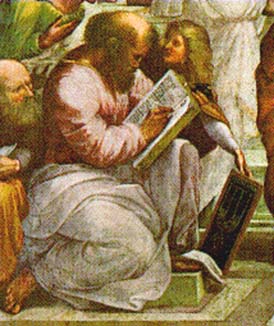
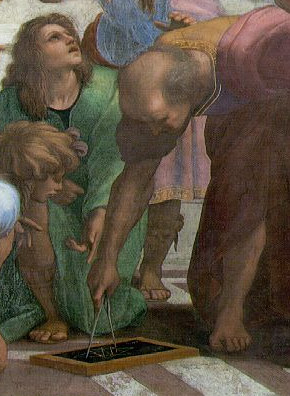
I draw the bisectors of the base-angles of the triangle, the extension of which points directly to Thucydides and Aeschenes. Then, I extend the lines of the triangle’s sides towards Apollo and Athena, I connect the ending points and another isosceles triangle is created!


I draw the bisectors of the two angles of the new triangle, and they once again point to Thucydides and Aiskenes. Then, from the center of the circle, I draw the verticals of the two isosceles triangles. The extension of the line shows the perspective of the painting. The triangles’ vertical creates 4 rectangular triangles. From the latter, I draw the verticals of each right angle. The straight line which unites the two intersections of the four verticals passes from the center of the painting and intersects all of the philosopher’s heads.
Conclusion: The major impact of the ancient Greek way of thinking on Renaissance artists. The interrelationship of the ancient world’s sciences.
The greatness of Art as the highest form of expression.
Conclusion II : “Let no one ignorant of geometry enter” in Plato’s academy. It seems that the ones who did enter, did it through Raphael’s brush. None the less, we, the fresco’s admirers, “entered” the painting only when we discovered the geometrical patterns that are revealed in the painting. Only then did we come to appreciate the deep symbolism it conveys.
First Fibonacci poem from Amsterdam
Here is my own Fibonacci poem. It's more about our project than about bread...
The rest will come in an ebook about Fibonacci poems.
Wiskunde?
Brood?
Eén gedicht?
Kan dat wel?
In a Taste of Mathematics?
In dit project mengen we wiskunde en voedsel!
Dit gedicht is gebaseerd op de rij van Fibonacci, bekend van de konijnen.
Brood eten we allemaal in alle landen van ons project, maar Nederland staat bekend om de kaas die we daarop eten!
Wiskunde is overal om ons heen: denk aan de natuur in combinatie met de rij van Fibonacci, denk aan het rekenen met geld in het dagelijks leven, denk aan architectuur met zijn gulden snede.
Maar het belangrijkste is dat de wiskunde nu zes landen verbindt: Spanje, Griekenland, Italië, Tsjechië, Roemenië en Nederland werken samen en wisselen hun cultuur uit met de andere landen over het onderwerp voedsel en we proberen dat te doen door te kijken hoe voedsel samenhangt met wiskunde door bijvoorbeeld leuke raadsels over wiskunde en eten.
Deze regel zal zeker de laatste zijn, aangezien negenentachtig woorden al moeilijk genoeg is om als één regel te schrijven en het zo goed als onmogelijk zal zijn om een regel te maken met honderdenvierenveertig woorden en een wiskundige is wel goed met getallen, maar het schrijven van een gedicht ligt erg ver van zijn abstracte geest af, dus het is verstandiger om dan maar weer wiskunde en voedsel te combineren, wat voor velen ook al erg vreemd is, maar in dit project wordt aangetoond dat dat leuk is.
Mathematics?
Bread?
One poem?
Is that possible?
In a Taste of Mathematics?
In this project we mix mathematics and food!
This poem is based on the sequence of Fibonacci, known from the rabbits.
We all eat bread in all the countries of our project, but the Netherlands are known for the cheese on top.
Mathematics is all around us: think about the nature in combination with the sequence of Fibonacci, think about calculations with money in ordinary day life and even think about architecture and the golden ratio.
But the main part is that mathematics is connecting six countries: Spain, Greece, Italy, the Czech Republic, Romania and the Netherlands are collaborating and exchanging their culture with the other countries about the subject food and we try to do that by seeing how food and mathematics connect by solving riddles about mathematics and food.
This line will definitely be the last one, because eighty-nine words are hard enough to write in one single line and it will be pretty close to impossible to make a single line with one-hundred-and-forty-four words and a mathematician may be good with numbers, but writing a poem like this is a long way of his totally abstract mind, so it might be a lot wiser to mix mathematics and food again, something very odd for many people, but in this project it is shown to be great fun.

The rest will come in an ebook about Fibonacci poems.
Wiskunde?
Brood?
Eén gedicht?
Kan dat wel?
In a Taste of Mathematics?
In dit project mengen we wiskunde en voedsel!
Dit gedicht is gebaseerd op de rij van Fibonacci, bekend van de konijnen.
Brood eten we allemaal in alle landen van ons project, maar Nederland staat bekend om de kaas die we daarop eten!
Wiskunde is overal om ons heen: denk aan de natuur in combinatie met de rij van Fibonacci, denk aan het rekenen met geld in het dagelijks leven, denk aan architectuur met zijn gulden snede.
Maar het belangrijkste is dat de wiskunde nu zes landen verbindt: Spanje, Griekenland, Italië, Tsjechië, Roemenië en Nederland werken samen en wisselen hun cultuur uit met de andere landen over het onderwerp voedsel en we proberen dat te doen door te kijken hoe voedsel samenhangt met wiskunde door bijvoorbeeld leuke raadsels over wiskunde en eten.
Deze regel zal zeker de laatste zijn, aangezien negenentachtig woorden al moeilijk genoeg is om als één regel te schrijven en het zo goed als onmogelijk zal zijn om een regel te maken met honderdenvierenveertig woorden en een wiskundige is wel goed met getallen, maar het schrijven van een gedicht ligt erg ver van zijn abstracte geest af, dus het is verstandiger om dan maar weer wiskunde en voedsel te combineren, wat voor velen ook al erg vreemd is, maar in dit project wordt aangetoond dat dat leuk is.
Mathematics?
Bread?
One poem?
Is that possible?
In a Taste of Mathematics?
In this project we mix mathematics and food!
This poem is based on the sequence of Fibonacci, known from the rabbits.
We all eat bread in all the countries of our project, but the Netherlands are known for the cheese on top.
Mathematics is all around us: think about the nature in combination with the sequence of Fibonacci, think about calculations with money in ordinary day life and even think about architecture and the golden ratio.
But the main part is that mathematics is connecting six countries: Spain, Greece, Italy, the Czech Republic, Romania and the Netherlands are collaborating and exchanging their culture with the other countries about the subject food and we try to do that by seeing how food and mathematics connect by solving riddles about mathematics and food.
This line will definitely be the last one, because eighty-nine words are hard enough to write in one single line and it will be pretty close to impossible to make a single line with one-hundred-and-forty-four words and a mathematician may be good with numbers, but writing a poem like this is a long way of his totally abstract mind, so it might be a lot wiser to mix mathematics and food again, something very odd for many people, but in this project it is shown to be great fun.

2.10.2011
More about Fibonacci and Arts
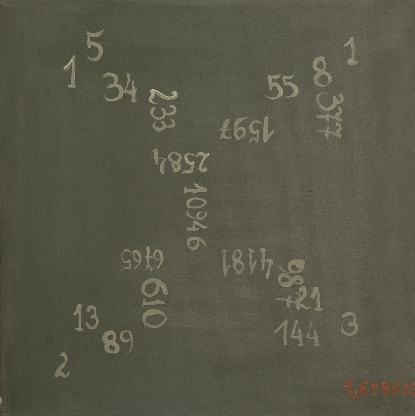
"Fibonaccis Traum" Painting by Martina Schettina 2008
We also found this wonderful musical score based on Fibonacci numbers. Enjoy!
We also found this wonderful musical score based on Fibonacci numbers. Enjoy!
2.09.2011
Fibonacci in art

The flight of numbers by artist Mario Merz, a luminous equipment on the Mole Antonelliana in Turin - Italy, represents Fibonacci numbers.
Do you know any other artistic works inspired to Fibonacci numbers?
Yes, in fact this is what we found: on the chimney of the power station in Turku (Finland) one can see the Fibonacci numbers from 1 to 55. They actually are 2m high neon lights. The building was also designed by Mario Merz and it was the first commission of an environmental art project in 1994. The architect calls it "a metaphor of the human quest for order and harmony among chaos." (source here)
Yes, in fact this is what we found: on the chimney of the power station in Turku (Finland) one can see the Fibonacci numbers from 1 to 55. They actually are 2m high neon lights. The building was also designed by Mario Merz and it was the first commission of an environmental art project in 1994. The architect calls it "a metaphor of the human quest for order and harmony among chaos." (source here)


2.08.2011
The second Fibonacci bread poem from Bucharest
 We wrote this one in Romanian first, so to be quite honest, it sounds better in our own language.
Golden
wheat
is where
the bread begins.
Hands are printed in it
as in a mysterious steaming fairy-tales book.
Many lives were sacrificed for the earth that this wheat has grown from.
For souls filled with warm aroma, for the energy of young bodies, bread is a gift from the mist of time.
Romanian version
Auriul
spic
de grâu
e începutul pâinii.
În pâine multe mâini citim,
ca într-o carte de poveşti aburind misterios.
Multe vieţi s-au jertfit pentru pământul din care acest gâu a-ncolţit.
Pentru sufletele noastre îmbălsămate de căldură şi pentru energia trupurilor tinere, pâinea e un dar trimis de strămoşi din negura timpului.
2.07.2011
The first Fibonacci poem from Bucharest
Maybe there will be more, it's a work in progress. Please remember I'm just a Math teacher and don't be too strict!
 This
This
yellow
shining brightly
on our flag
between the red and blue-
the bread between the blood and the sky-
is nothing less than the line of our history, the reason, the "why".
The bread our parents put on the table when the day ends, a tired smile in their eyes, is the time.
Romanian version:
Galbenul
acesta
strălucind aprins
pe drapelul naţional
aşezat între roşu şi-albastru,
e chiar pâinea stând între sânge şi cer,
e istoria noastră întreagă, reală, cu-ncercări şi strămoşi care luptă şi pier.
Pâinea caldă pusă seara pe masă de părinţii noştri ce ne zâmbesc cu ochi obosiţi nu-i altceva decât timpul etern.
 This
Thisyellow
shining brightly
on our flag
between the red and blue-
the bread between the blood and the sky-
is nothing less than the line of our history, the reason, the "why".
The bread our parents put on the table when the day ends, a tired smile in their eyes, is the time.
Romanian version:
Galbenul
acesta
strălucind aprins
pe drapelul naţional
aşezat între roşu şi-albastru,
e chiar pâinea stând între sânge şi cer,
e istoria noastră întreagă, reală, cu-ncercări şi strămoşi care luptă şi pier.
Pâinea caldă pusă seara pe masă de părinţii noştri ce ne zâmbesc cu ochi obosiţi nu-i altceva decât timpul etern.

2.05.2011
2.04.2011
Infected or curious?
 This is part of a painting in Spanish Navy Museum at San Fernando. It shows: Churruca from Trafalgar battle story. He's holding a paper with some writing about Diferential Calculus, isn't he?
And
 The mathematician could be working on the Unit Circle that explains the Trigonometric Functions.
Did I do well?
Now, you made me feel curiosity and found this site:
http://mateturismo.wordpress.com/category/pintura/page/6/
A Maths drawing
 Maurits Cornelis Escher, known by its initials, MC Escher (born 17 June 1898 - d. 27 March 1972) was an artist, engraver and illustrator from the Netherlands . He lived for many years in The Hague, where a museum was opened in his honor, the Escher Museum.
His most famous works have as a starting point impossible objects and optical illusions.
Our question is: what famous Mathematical object can you see in this drawing?
The official Escher site is here.
The Fibonacci poem from Greece

Fighting
Famine
Bread, Beans
Poor man’s food
Savored once in ancient Greece
Wheat was gifted by the gods to us
Soup made of holy beans, raised the world’ s brightest brains whose methodology remains
Beans, Bread, as divine med, sent from heaven to heal and spread.
Wondrous works were read and made within philosophy’s array.Μια
Φασολάδα
Και ψωμί
Ισοδυναμεί με ευχή
Στων τότε Ελλήνων το τραπέζι
Ευλογία των θεών, είν’ το «κρέας των φτωχών»
Σίτος, δώρο της θεάς, άρτος έγινε για μας, παντού δίνοντας ζωή, ανάλαφρη αναπνοή
Μαθηματικά μυαλά ξύπνησαν με όλ’ αυτά, και φιλόσοφοι μεγάλοι άρχισαν ανεμοζάλη στων επιστημών τον κόσμο όλα άλλαξαν διαμιάς κι έμειναν αθάνατα.
More mathematics in arts
I have found another painting which involves mathematics.
It is a painting of the English mathematician John Wallis (1616-1703).
It is made in 1648 by the Dutch painter Ferdinand Bol and is called:
“Portret van een mathematicus” (Portret of a mathematician).


It is a painting of the English mathematician John Wallis (1616-1703).
It is made in 1648 by the Dutch painter Ferdinand Bol and is called:
“Portret van een mathematicus” (Portret of a mathematician).


2.03.2011
Spanish team Fibonacci BREAD poem

Golden
wheat,
our wealth
in ancient fields.
Harvesting, threshing, grinding in mills
for soft flour to be kneaded into BREAD,
in the solitary dawn of the baker’s strong hand, the crusty wrapping waits.
For the poor and the rich. For toothless crawling eaters and walking ones. For slim purses and huge hearts, a TREASURE.
SPANISH TEAM FIBONACCI BREAD POEM in SPANISH
Trigo
dorado,
nuestra riqueza
de tierras antiguas.
Cosecha, trilla, molienda en molinos
para que harina suave se amase en PAN,
en el alba solitaria de manos fuertes de panadero, el crujiente envoltorio espera.
Para pobres y ricos. Para comensales desdentados que gatean y los que caminan. Para bolsillos delgados y corazones inmensos, un TESORO.
1.31.2011
Let's write a Fibonacci poem!

Here is a new challenge, one that brings together Maths, poetry, food and learning about each other- we hope you find it appetizing!
But, first, a few words about Fibonacci and his numbers.
Fibonacci (c. 1170 – c. 1250) was an Italian Mathematician , considered by some "the most talented western mathematician of the Middle Ages". He is best known for spreading the nowadays Arabic numeral system in Europe and and for the number sequence named after him.
The first two numbers in his sequence are 0 and 1, then each number is the sum of the previous two: 0, 1, 1, 2, 3, 5, 8, 13, 21, 34, 55, 89...that is
 There are many interesting things about these numbers, but maybe the most intriguing is they appear very often in nature: the petals of flowers, the arrangement of leaves on a stem or branches on a tree, the bees or rabbits population numbers, the fruitlets of a pineapple, the flowering of artichoke, an uncurling fern and the arrangement of pine cones and more, as you can see in the video.
We have already seen that Math and poetry are sometimes connected and one way of doing that is writing poems that have a Mathematical form, such as Fibonacci poems: the first two lines have 1 word, then 2 words, 3, 5, 8 etc.
Let us try to write a Fibonacci poem for each team, a bilingual poem (in English and our mother tongue) about bread (and what it means to us). It will help us learn more about our cultures and- why not?- about numbers and words!
Photo source and more information on the Fibonacci sequence here.
1.26.2011
Answer from Amsterdam to the Mathematical Painting.
Answer Mathematical Painting
Here our answer to the mathematical painting. We didn't give an answer to the painter and the name since that answer was already given.
This subject of removing brackets was by coincidence our last subject in our schoolbook!
Here our answer to the mathematical painting. We didn't give an answer to the painter and the name since that answer was already given.
This subject of removing brackets was by coincidence our last subject in our schoolbook!
Subscribe to:
Posts (Atom)